Recipe
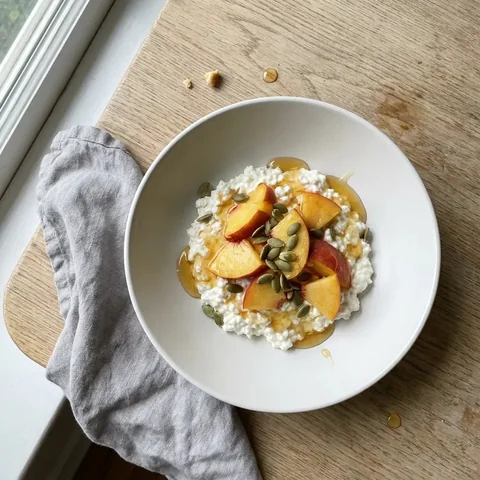
Cottage cheese bowl with nectarine and pistachios
A cup (225 g) of full-fat cottage cheese topped with a sliced nectarine, a teaspoon of honey and 10 g of pistachios has 29.5 g of protein and 370 kcal, worked out from USDA FoodData Central. It takes five minutes and no cooking. Nearly all the protein is the cottage cheese; the fruit and nuts are for taste.
 Coming soon to theApp Store
Ingredients
For 1 bowl:
- 1 cup cottage cheese, full fat (225 g, about 8 oz)
- 1 medium ripe nectarine or peach (140 g), sliced
- 1 tsp honey (7 g)
- 10 g pistachios (about 15 kernels), roughly chopped
- A few mint leaves, if you have them
Steps
- Tip the cottage cheese into a wide bowl and spread it a little, so the toppings sit on top rather than sink.
- Slice the nectarine around the stone and lay it over the cottage cheese.
- Drizzle the honey, scatter the pistachios and mint.
- Eat it cold, straight away.
In winter, swap the nectarine for an orange in segments or a grated apple with cinnamon.
The numbers
Every line is the weight times USDA FoodData Central’s value per 100 g:
| Ingredient | Amount | Protein | kcal |
|---|---|---|---|
| Cottage cheese, full fat | 225 g | 26.1 g | 236 |
| Nectarine | 140 g | 1.5 g | 55 |
| Honey | 7 g | 0 g | 21 |
| Pistachios, dry roasted | 10 g | 2.1 g | 57 |
| The bowl | 29.5 g | 370 |
The bowl also has about 32 g of carbs and 14 g of fat. The cottage cheese gives 26 of the 29.5 g of protein, which is why the bowl works on a day when you can’t face much: it is soft, cold and small for what it holds.
Variations
| Version | Protein | kcal |
|---|---|---|
| The recipe above | 29.5 g | 370 |
| Lowfat 2% cottage cheese instead of full fat | 28.5 g | 320 |
| Savoury: tomato, cucumber and a teaspoon of olive oil instead | 27.5 g | 310 |
| With half a cup more cottage cheese (338 g in all) | 43 g | 490 |
- Savoury: 100 g each of diced tomato and cucumber, a teaspoon of olive oil (4.5 g), black pepper and a pinch of dried herbs or za’atar.
- Lighter: lowfat 2% cottage cheese instead of full fat saves about 50 kcal and keeps nearly all the protein.
- More protein: a bigger scoop of cottage cheese is the simplest way; the toppings stay the same. For more ideas, see ways to eat cottage cheese.
Where Fond helps, and where it doesn’t
A meal can be snapped, said, or scanned from a barcode or a nutrition label. So a tub of cottage cheese is a barcode scan away. A scanned barcode is looked up in your own foods first, then in Open Food Facts; when nobody knows it, the label camera is next. You can search foods, add your own, and log your usual meals in one tap.
The numbers on this page are USDA’s averages for full-fat cottage cheese; brands are close but not the same, and the label on your tub is the one to trust. Fond doesn’t know how full your spoon of honey was. It is not a dietitian either: if you’re eating less because of a medication or an illness, ask your clinician how much protein you should aim for.
Questions and answers
Which cottage cheese has the most protein?
They are close. Per 100 g, USDA FoodData Central gives full-fat cottage cheese 11.6 g of protein and 105 kcal, lowfat 2% 11.0 g and 84 kcal, and lowfat 1% 12.4 g and 72 kcal. What changes most is the fat. A 225 g cup has about 236 kcal full fat, 189 kcal at 2% and 162 kcal at 1%.
Can I make it the night before?
Put the cottage cheese in a jar with the nuts in a separate bag, and slice the fruit in the morning so it stays fresh.
Sources
What this page says about Fond was checked against the app on .
Get Fond
Logging, barcode scans, food search, your plan and your progress are free.
Coming soon to theApp Store