GLP-1
Tracking food on a GLP-1: protein first, the rest second
On a GLP-1 medication, tracking is less about policing calories and more about making sure you eat enough of the right things. The most useful numbers are protein, water, fiber, and how you feel each day. Logging also gives your care team real information. Keep it light: a photo or a sentence is enough.
 Coming soon to theApp Store
Waiting for review by a licensed dietitian
Why track at all when you’re barely eating?
Because “barely eating” is the problem tracking catches. The 2025 joint advisory from four nutrition and obesity societies warns that the big drop in intake on GLP-1 medications can leave people short of protein, vitamins and minerals, and fluids, and that side effects can make it worse. Without some record, it’s easy to think you ate “fine” on a day that was mostly coffee and two crackers.
The advisory also lists self-monitoring of food intake, weight and activity among the habits linked to long-term success, and describes dietary-tracking apps and photo food logs that a dietitian can review as tools for support during treatment.
What’s worth tracking
| Track | Why |
|---|---|
| Protein | The number most likely to fall short when appetite drops |
| Water | Thirst fades; dehydration from vomiting or diarrhea is a label warning |
| Fiber | Constipation is common; fiber plus fluid helps |
| Side effects | Patterns (which days, which foods) are useful for your clinician |
| Doses, as taken | So your record matches your prescriber’s plan |
| Weight, weekly | Trends over weeks, not daily swings |
| Strength sessions | The advisory pairs protein with them to keep muscle |
What you can usually worry about less: exact calories at every meal, every gram of carbs, and perfect accuracy. A rough log you keep up beats a precise one you abandon.
Keep it light
- Log by photo or a sentence. “Two eggs and toast” is enough.
- Log the protein-carrying food first; skip the cucumber slices if they slow you down.
- Repeat meals. On a GLP-1, people tend to eat the same few small meals. Save them and log them in one tap.
- Look at the week, not the day. One low day is normal. A low week is worth noticing.
Read your log for patterns
After a few weeks, a log answers useful questions:
- Which days after a dose do I eat least? (see the dose-week pattern)
- Am I reaching my protein floor on those days?
- Do certain foods come before nausea or reflux?
- Am I drinking enough on the days I feel worst?
These are descriptions, not diagnoses. Bring them to your care team.
When to stop tracking and call
A log won’t help with vomiting that won’t stop, being unable to keep fluids down, signs of dehydration or severe stomach pain. Those need your clinician, straight away.
A low-effort routine
Five minutes a day is plenty:
- At each meal, take a photo or say what you ate in one sentence.
- Once a day, glance at protein and water. On track? Done. Short? Add a yogurt, a glass of milk or a glass of water.
- If something felt off (nausea, reflux, constipation), note it in a few words.
- Once a week, look back: average protein, the quietest days, anything that repeated.
Skipped a day? Leave the gap. A log with gaps still shows patterns; a log you stop keeping doesn’t.
Where Fond helps, and where it doesn’t
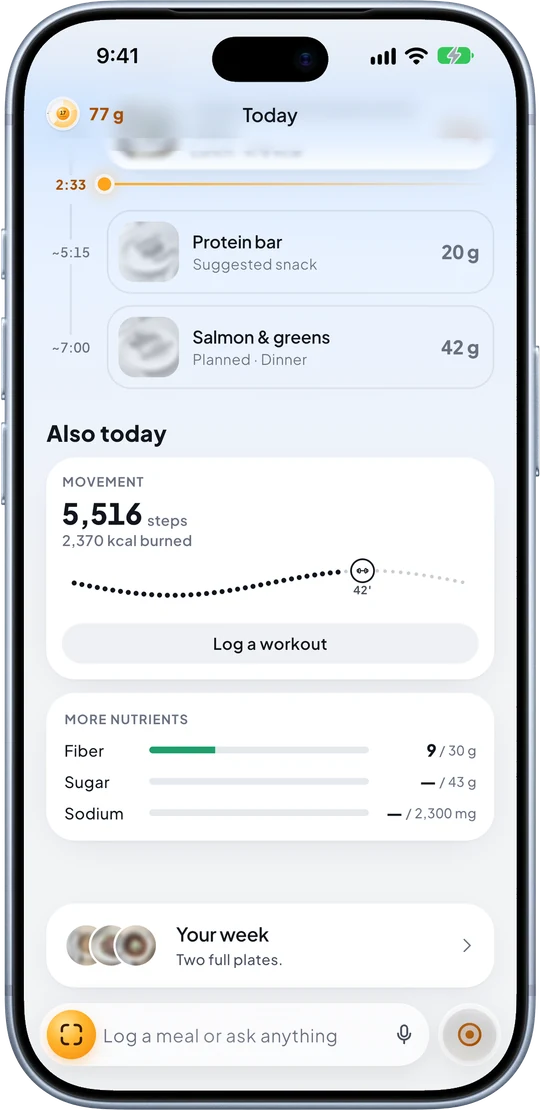
Your plate fills as you eat, with the protein still to go. A meal can be snapped, said, or scanned from a barcode or a nutrition label. Fond logs your doses and side effects, reminds you on your prescriber’s schedule, and keeps protein front and center on low-appetite days. The side-effect check-in lists nausea, constipation, diarrhea, heartburn, sulfur burps, no appetite and thirst, among others. You can share a one-page summary of your week with your dietitian, or a PDF for your next appointment. A photo log is an estimate, not a weighed record, and Fond never gives medical or dosing advice: Fond logs and informs. It doesn’t give medical or dosing advice.
Questions and answers
Do I need to count calories on a GLP-1?
Your care team will tell you how closely to watch calories. For many people, the medication already makes them eat less, and the bigger risk is eating too little protein. Watching protein first and calories second is a common, lighter approach.
What if logging makes me anxious about food?
Stop, or log less. Logging is a tool, not an obligation. If food or numbers have started to feel stressful, tell your clinician; your wellbeing matters more than a complete log.
Sources
What this page says about Fond was checked against the app on .
Get Fond
Logging, barcode scans, food search, your plan and your progress are free.
Coming soon to theApp Store